Learning Outcomes:
i. Define imprinting and explain its role in forming strong attachments in certain animals.
ii. Explore the work of Konrad Lorenz and his observations on geese imprinting on unusual objects.
iii. Understand the critical period for imprinting and its impact on social bond development.
iv. Appreciate the fascinating interplay between innate behavior and experience in shaping animal behavior.
Introduction:
Imagine a world where the first moving object a newborn sees becomes its parent. This might sound like a quirky tale, but it's the reality of imprinting, a phenomenon where certain animals form strong attachments during a critical period early in life. In this lesson, we'll embark on an adventure into the world of imprinting, guided by the pioneering work of Konrad Lorenz, the man who followed a flock of geese down the path of scientific discovery.
i. The Geese and their Waddling Father: Lorenz's Observations
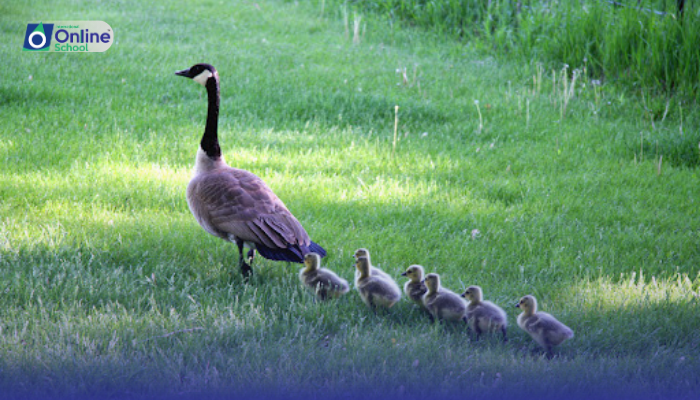
In the 1930s, Konrad Lorenz, a curious Austrian ethologist, noticed something extraordinary. Geese, known for their strong filial bonds, were forming attachments not to their mother geese, but to the first moving object they encountered after hatching. Imagine a gosling following a rolling ball, a waddling duck, or even Lorenz himself, his white coat mistaken for a giant mother goose. These seemingly absurd observations were the first clues to the fascinating world of imprinting.
ii. The Critical Period: A Time for Bonding
Imprinting happens during a specific window of time called the critical period. For geese, this window is just a few hours after hatching. During this period, the gosling's brain is primed to form strong attachments to whatever moving object it sees, regardless of its species. This attachment is not learned; it's an innate behavior triggered by the critical period and the object's movement.
iii. Beyond the Goose: The Diversity of Imprinting
While geese are the classic example, imprinting is not limited to them. Ducks, swans, and some birds also exhibit this phenomenon. Interestingly, research suggests that even some mammals, like sheep and deer, might form imprinting-like attachments to their mothers during specific sensitive periods.
iv. The Nature-Nurture Dance: Imprinting and Experience
Imprinting is not a rigid script; it's a dance between innate behavior and experience. While the critical period sets the stage for attachment, the specific object of the gosling's affection can be influenced by its surroundings. For example, a gosling raised with other geese might imprint on them, even if it initially followed a human. This interplay between innate tendencies and experience highlights the remarkable adaptability of animal behavior.
Lorenz's work on imprinting opened our eyes to a fascinating phenomenon that challenges our traditional notions of parent-child relationships. It reminds us that the development of social bonds in animals is not just about genetics or learning; it's a complex interplay between innate predisposition, critical periods, and the unique experiences each individual encounters. So, the next time you see a gosling waddling after a dog or a duckling following a human, remember that you're witnessing the echoes of Lorenz's discoveries, a testament to the beautiful and unexpected ways nature shapes the bonds that connect us all.
